
Aluminum Wiring in Homes: What Buyers and Homeowners Need to Know
March 23, 2026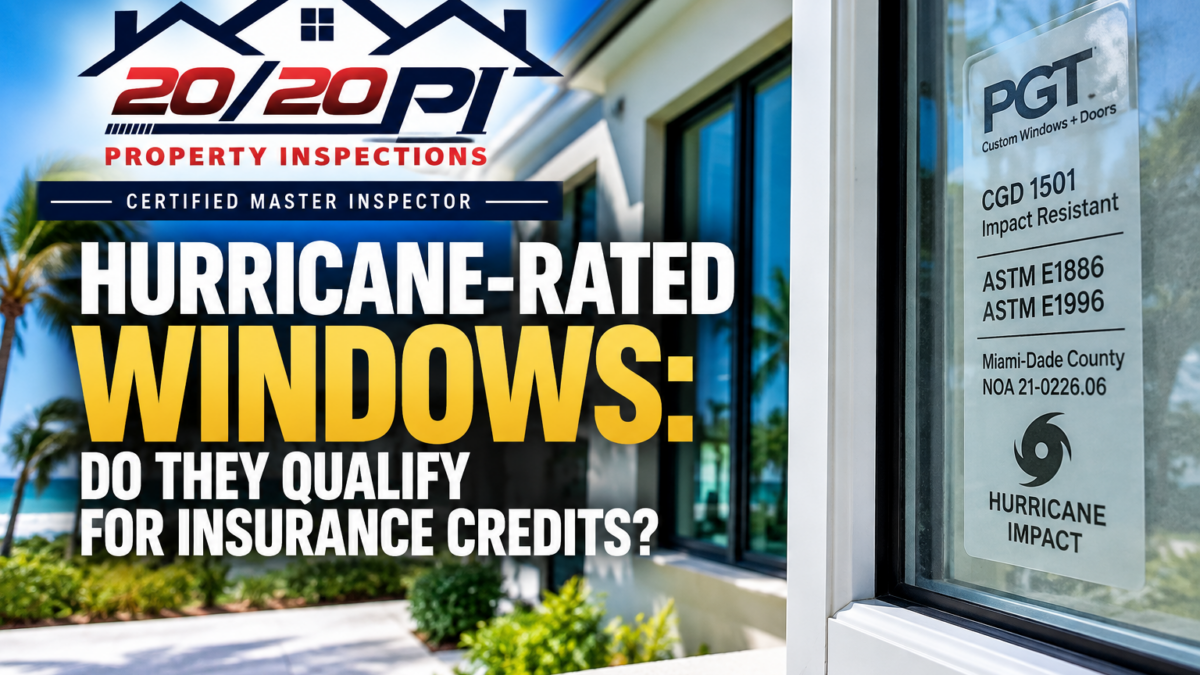
The Property Sage | 20/20 Property Inspections
Illustrative example of an impact-resistant window label. Actual product approvals and manufacturer documentation must be verified.
Your Builder Said Your Windows Were Hurricane-Rated. So Why Didn’t You Receive the Insurance Credit?
This is one of the most frustrating misunderstandings we encounter during wind mitigation inspections in Florida.
A homeowner purchases a property believing it has hurricane-rated windows. The builder, seller, or window installer may have represented the windows as meeting hurricane standards.
Then a wind mitigation inspection is performed, and the homeowner discovers that the available documentation does not establish the opening-protection classification they expected.
Understandably, this can be frustrating.
However, there is an important distinction between a window being described as hurricane-rated and having documentation demonstrating compliance with the specific impact-protection requirements used for insurance purposes.
What Does Hurricane-Rated Actually Mean?
Not all hurricane-rated windows are created equal.
Some windows are designed to withstand high wind pressures but are not necessarily rated to withstand impacts from windborne debris.
Other windows are manufactured and tested to meet specific impact-resistance standards.
Having dual-pane glass, tinted windows, or aftermarket window film does not automatically mean your windows qualify for hurricane opening-protection insurance credits.
Likewise, a builder’s statement that a home has hurricane-rated windows does not, by itself, establish that the installed windows meet the applicable impact-protection requirements.
The manufacturer’s testing, product approval, impact classification, and supporting documentation are what matter.
How Can You Identify Impact-Rated Windows?
During thousands of wind mitigation inspections, we have encountered many different window manufacturers, labels, and product identification methods.
One of the first things an experienced inspector looks for is the manufacturer’s identification and impact-rating information.
Look for the Manufacturer’s Sticker or Glass Markings
For many years, we commonly encountered gold-colored manufacturer’s stickers identifying window testing standards and other product information.
Today, labels may look different. Some manufacturers use paper labels, while others provide permanent identification or markings etched into the glass.
The color or appearance of the sticker is not what establishes compliance.
What matters is whether the identification and supporting documentation establish that the installed window meets the applicable impact-protection requirements.
What ASTM Standards Should You Look For?
Two commonly recognized testing standards for hurricane impact-resistant windows are:
- ASTM E1886: The standard test method addressing windborne debris impact and cyclic pressure testing of exterior windows, doors, and protective systems.
- ASTM E1996: The standard specification establishing performance requirements for products exposed to windborne debris in hurricanes.
You may also encounter Miami-Dade testing standards:
- TAS 201: Impact testing.
- TAS 202: Uniform structural pressure testing.
- TAS 203: Cyclic wind-pressure testing.
These standards are commonly associated with hurricane-resistant window testing and product approvals.
However, simply seeing one of these numbers does not automatically establish eligibility for an insurance credit. The product’s impact classification, approval documentation, and applicable requirements must also be considered.
What if My Windows Don’t Have a Sticker?
The absence of a visible manufacturer’s sticker or glass marking does not automatically mean the window is defective or incapable of providing hurricane protection.
However, if the installed product cannot be identified and its qualifying impact resistance cannot be verified through acceptable documentation, the inspector cannot simply assume it meets the applicable standard.
This is where misunderstandings frequently occur.
A homeowner may have been told that the builder installed hurricane-rated windows. The windows may be relatively new, have two panes of glass, and appear substantially constructed.
But appearances and verbal representations are not substitutes for verifiable impact-protection information.
Our responsibility is to document what can be verified, not what someone believes should qualify.
Why One Window Can Affect Your Entire Opening-Protection Classification
This is perhaps the most important point for homeowners to understand.
It may take only one nonqualifying window or other applicable opening to prevent a home from receiving the anticipated whole-building opening-protection classification.
For example, imagine a home with fifteen windows that meet the applicable impact-protection requirements.
However, one additional window does not meet those requirements or lacks acceptable documentation establishing compliance.
That single opening can affect the classification of the entire home’s opening protection.
The same principle can apply to an unprotected glass insert in an exterior door or another applicable opening.
The inspection is not simply a matter of counting how many windows are hurricane-rated.
It involves determining the applicable protection classification based on the requirements of Florida’s wind mitigation inspection form.
Why Didn’t My Inspector Check Every Window?
Homeowners sometimes question why their wind mitigation inspector did not spend considerable time examining every individual window.
The answer may be simpler than expected.
An experienced inspector may recognize a nonqualifying opening almost immediately.
When that opening establishes the lowest applicable protection classification, examining additional windows may not improve the classification.
For example, if an inspector identifies a window that clearly does not meet the applicable impact-protection requirements, examining another fifteen windows may not change the result for that particular classification.
This does not eliminate the inspector’s responsibility to complete the observations and documentation required by the inspection form.
It simply explains why identifying an opening-protection limitation can happen relatively quickly.
An inspector may spend considerable time in the attic examining roof construction, roof-to-wall connections, and other required features while recognizing an opening-protection limitation during a brief exterior examination.
The quality of an inspection is determined by accurate observations, appropriate documentation, and compliance with the inspection requirements—not simply the number of minutes spent looking at windows.
Experience matters.
Why Does My Wind Mitigation Report Say “No”?
Another common misunderstanding occurs when homeowners review Florida’s Uniform Mitigation Verification Inspection Form, commonly called the OIR-B1-1802.
They see a “No” response or notice that a particular qualifying protection option was not selected.
Some assume this means the inspector personally denied them an insurance discount.
That is not what the inspector does.
The inspector documents the observed conditions and supporting evidence using the classifications established by the inspection form.
If a particular qualifying protection feature cannot be established, the inspector cannot identify it as present simply because the homeowner expected it.
A “No” response does not necessarily mean the window is defective, improperly installed, or incapable of resisting hurricane conditions.
It means the specific condition addressed by that question has not been established.
The inspector must complete the applicable form selections and supporting documentation accurately.
The Inspector Does Not Determine Your Insurance Discount
This distinction is especially important.
The inspector does not approve, deny, or calculate your insurance credit.
The inspector’s responsibility is to document the property’s observable wind-resistant features and supporting information.
The insurance carrier reviews the inspection report and determines which credits apply under its rating requirements.
A homeowner may disagree with the findings because the builder advertised the home as having hurricane-rated windows.
However, the inspector cannot change the documented classification simply because an insurance discount was anticipated.
Our responsibility is to report the conditions accurately.
What Should Homeowners and Realtors Do?
Before purchasing a home or replacing windows, request the manufacturer’s product approval information and installation documentation.
If an opening-protection insurance credit is important to your purchase decision, verify the supporting information before relying on anticipated insurance savings.
If you believe an opening was incorrectly classified, provide the inspector with additional manufacturer identification, product approvals, or other acceptable documentation for review.
Florida implemented a revised OIR-B1-1802 wind mitigation inspection form effective April 1, 2026, making accurate classifications and supporting documentation particularly important.
Education Helps Prevent Expensive Misunderstandings
At 20/20 Property Inspections, we believe homeowners and Realtors should understand what a wind mitigation inspection actually establishes.
Our goal is not to tell homeowners what they want to hear.
Our responsibility is to accurately document the property, explain our findings, and provide reliable information that helps consumers make informed decisions.
The Property Sage | 20/20 Property Inspections
Helping Florida Property Owners Understand What They Own.
One Call Tackles It All.
Educational information only. Individual opening-protection classifications depend on the applicable inspection form, verified product information, and supporting documentation. Insurance carriers determine the applicable discounts.